




Schiphol verwacht sterke daling vervoer in 2009
Nieuws -> SchipholBron: Schiphol Group
05-01-2009
Vorig jaar hebben 47,4 miljoen passagiers gebruik gemaakt van Amsterdam Airport Schiphol; 0,8 % minder dan in het jaar ervoor. Het aantal vliegtuigbewegingen in het handelsverkeer daalde met 1,8 procent tot 428.350. Ook het vrachtvervoer nam in 2008 af, met 1,4 procent tot 1.588.000 ton. Deze voorlopige cijfers maakte Jos Nijhuis, President-directeur van Schiphol Group, bekend tijdens de nieuwjaarsreceptie. Dit jaar verwacht Schiphol een sterke daling van het passagiers- en vrachtvervoer en het aantal vliegtuigbewegingen met naar verwachting tussen de 6% en 10%.
Reden voor de verwachte sterke daling van het passagiers- en vrachtvervoer en het aantal vliegtuigbewegingen is de wereldwijde financiële crisis. Daarnaast was de invoering van vliegbelasting op 1 juli jl. een oorzaak voor de daling van het aantal passagiers in 2008. Met name low cost maatschappijen voerden om die reden een kwart minder vluchten uit op Schiphol.
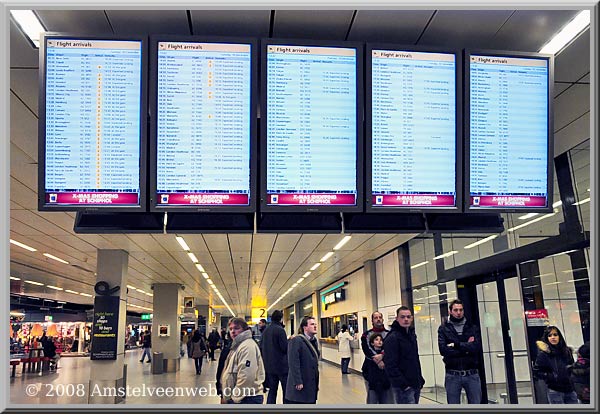
(Amstelveenweb.com collectie - 2008)
Aankomstijden schermen op Schiphol
"Niemand weet hoe lang en diep de recessie zal zijn waarin we terecht zijn gekomen. In augustus dachten we nog dat het aantal passagiers in 2009 met 1% zou dalen. Maar het effect van de wereldwijde financiële crisis is de laatste maanden van 2008 steeds sterker geworden. Het noodzaakt ons als bedrijf om onze strategie als bedrijf te herijken. Over een maand denken we daarover meer duidelijkheid te kunnen geven. Belangrijk is het behoud van onze maatschappelijke functie en van een efficiënte operatie.
Daarbinnen moeten we een antwoord vinden op de opkomende concurrentie van andere luchthavens en de noden van de luchtvaartmaatschappijen. We zullen in ieder geval de geplande investeringen voor 2009 bijstellen. Een paar maanden geleden gingen we nog uit van ca. 470 miljoen euro aan investeringen in 2009. Maar daarvan hebben we een aantal projecten tot een totaalbedrag van 180 miljoen tot in ieder geval 1 april uitgesteld, "aldus Nijhuis.
Verantwoord ondernemen
De heer Nijhuis gaf aan verantwoord ondernemen te zien als een integraal onderdeel van de strategie voor de toekomst van Schiphol. Om die reden zal hierin ook het komende jaar geïnvesteerd blijven worden. Zo is in 2008 als onderdeel van het Klimaatplan de Blauwdruk Energie en de Visie Duurzame Mobiliteit opgesteld.
Schiphol wil in 2012 voor wat haar eigen activiteiten betreft CO2-neutraal zijn en in 2020 minimaal 20% van de eigen energiebehoefte op een duurzame wijze op de locatie opwekken. Daarnaast wil Schiphol ook de emissies van NOx verminderen en de bereikbaarheid van de luchthaven verbeteren.
Luchtvaartnota
Nijhuis sprak de hoop uit dat het goede werk dat de deelnemers aan de Alderstafel hebben verricht, zijn weerslag zal krijgen in de Luchtvaartnota die het kabinet dit voorjaar wil uitbrengen. "De overheid moet de voorwaarden scheppen om op Eindhoven en Lelystad 70.000 niet-mainportgebonden vluchten af te handelen. Op Schiphol blijft dan ruimte voor groei van het mainportgebonden verkeer. Daarbij moet Schiphol ervoor zorgen dat er op Lelystad en Eindhoven een aantrekkelijk, kostenconcurrerend product wordt neergezet. Wij geloven niet in gedwongen uitplaatsing omdat de markt zich niet laat uitplaatsen. Ook moet je niet teveel spreiden over teveel locaties. Om van beide luchthavens een succesvol alternatief te maken, moet er voldoende volume zijn", aldus de president-directeur van Schiphol Group.

(Amstelveenweb.com collectie - 2008)
De kusjesdeur op Schiphol wordt dagelijks door duizenden mensen bekeken. Door deze deur verlaten de meeste passagiers het douanegebied
Nijhuis sprak de verwachting uit dat de overheid zal zorgen voor betere concurrentievoorwaarden voor de luchtvaart in Nederland. "In de Luchtvaartnota moet aandacht zijn voor het economische belang van Schiphol op nationaal en regionaal niveau en voor het vestigingsklimaat. De aanwezigheid van Schiphol met zijn 260 directe internationale bestemmingen is immers één van de belangrijkste redenen voor internationale bedrijven om zich in deze regio te vestigen. In dit verband is het hoopgevend dat staatssecretaris Heemskerk een plan laat maken om vijftig internationale bedrijven naar Nederland te krijgen. "
De heer Nijhuis zei het verder hoopgevend te vinden dat minister-president Balkenende in oktober heeft gezegd, dat het kabinet wil voorkomen dat in 2012 een stapeling van kosten ontstaat die Schiphol in een negatieve concurrentiepositie brengt. Dat is het jaar waarin de luchtvaart in Europa mee moet gaan doen aan het Emissiehandelssysteem.
Amsterdam Airport Schiphol expects to see dramatic drop in passenger and cargo traffic over 2009
Last year, a total of 47.4 million passengers travelled through Amsterdam Airport Schiphol; 0.8% less than the previous year. The number of air transport movements dropped by 1.8% to a total of 428,350. Cargo traffic also saw a downward trend in 2008, dropping by 1.4% to a total of 1,588,000 tonnes. Schiphol Group President Jos Nijhuis announced these preliminary figures at the New Year's reception. This year, Schiphol expects to see a sharp drop in both passenger and cargo traffic, coupled with an expected 6% to 10% decline in air transport movements.
This expected decline in passenger and cargo traffic is a direct result of the global financial crisis. The introduction of the Air Passenger Tax on 1 July of last year has also contributed to the fall in passenger numbers. As a result of the tax, low cost carriers and various other airlines operated 25% fewer flights at Amsterdam Airport Schiphol.
"Nobody knows how long and deep the current recession will be", Mr Nijhuis said. "In August we thought that passenger numbers would decrease by another 1% in 2009. However, as the global financial crisis deepened in the final months of 2008 we have had to reassess our business strategy. In a month's time, we expect to be able to provide more clarity on the matter. What is important is that we maintain our social function and keep operating efficiently, whilst also developing a response to rising competition from other airports and to the needs of airlines. In any case, we will need to make adjustments to our budget and scheduled investments for 2009. Just a few months ago we had anticipated around €470 million in investments for 2009. But of these, several projects to the value of €180 million have been postponed at least until 1 April."
Corporate social responsibility
As Mr Nijhuis pointed out, corporate social responsibility will play a key role in the strategy for Schiphol's future and will remain a priority for investment over the coming year. 2008 saw the formulation of an Energy Blueprint and a Sustainable Mobility Concept as part of Schiphol Group's Climate Plan.
Amsterdam Airport Schiphol aims to be carbon neutral with regard to its own activities by 2012, and generate at least 20% of its energy on-site in a sustainable manner by 2020. The airport is also aiming to cut NOx emissions and improve its accessibility.
Aviation Policy Document
Nijhuis expressed his desire to see the efforts of the Alders Platform participants reflected in the government's Aviation Policy Document, which is to be published this spring. "The government needs to create conditions so that 70,000 non-mainport-dependent flights can be handled at Eindhoven and Lelystad, leaving room for the growth of mainport-dependent traffic at Schiphol. As a business, we need to ensure that Lelystad and Eindhoven are able to offer an attractive, cost-competitive product. We do not believe in forced relocation - the market will not allow itself to be displaced. Nor do we believe in spreading out flights over too many locations. Sufficient volume will be necessary in order to turn both airports into successful alternatives. A mere 10,000 flights will not be worthwhile," explained the Schiphol Group President.
Nijhuis expects to see the government improve the playing field in the Netherlands. "The Aviation Policy Document needs to consider the economic importance of Amsterdam Airport Schiphol at both national and regional level, and its significance for the business climate. After all, the presence of Schiphol with its approx. 260 international destinations is one of the most important motivators for international companies to establish themselves in this region.
In this context, it is promising that State Secretary Heemskerk for Economic Affairs recently commissioned McKinsey to draw up a plan to attract fifty international companies to the Netherlands."
Mr Nijhuis was also encouraged by Prime Minister Balkenende's statement in October that the government will work to prevent an accumulation of costs and subsequent negative effects on Schiphol's competitiveness in 2012, when European airlines are obliged to begin participating in the Emissions Trading Scheme.


